reabc/Anarchist Solution to the Problem of Crime/Anarchist Solution to the Problem of Crime.pdf
Web PDF • Imposed PDF• Raw TXT (OCR)
![vely only, against per- Obviously, ’freedom is U-restraint. Itis con. s3ibility of freedom to of violence to defensive measures only, The Abundant Economy: Prevajling economic Zystems, whether they call the, iali CaPitalist) use force to min ProPerty relations. Angrengs State power for any purpog o rangements, collectivigt. op make in a free society wil o Whatever economic ar. Tee-enterprise, people voluntary. There will les, like the rules of 5 made possible by tota] freedom indiv; Technology man race-- ’™ will allow 21 SuPply the basic needs of the entire hy; ventoday this is possible, Toge freedo D enormous increase in creativity, inventiveness, roductivity. Man enjoys wory When itisn’t alienat. ’8 and he isn’t coerced into it 2](Anarchist Solution to the Problem of Crime 6.png)

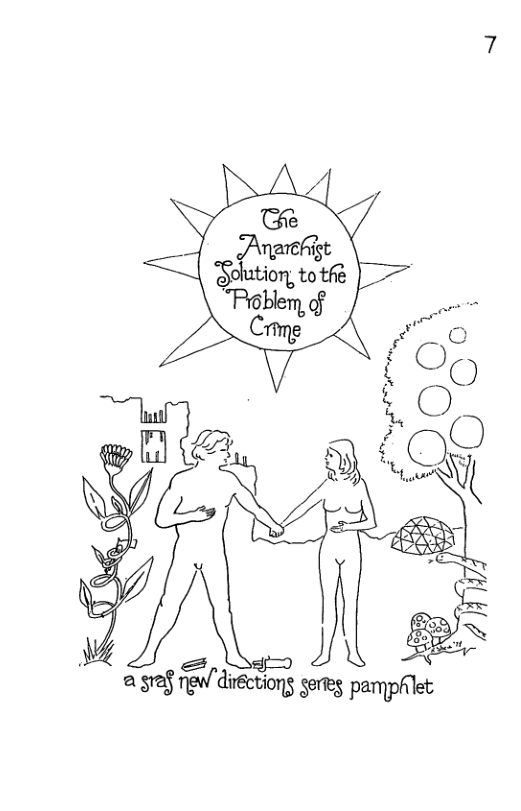
.?n.mfifist
Solutior, totfe
agef 'E-"f‘l‘m‘mls gene; pamphlet
T'he first thing people want from government
is that it maintain the peace and administer justice.
Yet governments have killed more people and seized
more goods than any private criminal ever has, and
today's governments threaten either to wipe out hu-
Ly in a nuclear war orto submerge the world in
a system of 1984-style superstates. Governmentand
law enforcement actually perpetuate the conditions
thatbreed crime- -poverty, racism, alienation, sexual
repression. Evenas the numbers of laws, judges and
jails increases, so do the rates of murder, rape,
assault, robbery, burglary and larceny.
Anarchists believe that if government is abo-
lished the evils it causes will disappear and the evil
it supposedly prevents - -antisocial behavior - -will get
noworseand may evendecrease. A popular miscon-
ceplion of anarchy pictures people running amok, a
complete breakdown of humane and sensible behavior.
This is not what anarchists aim at, since an orgy of
violence would immediately lead to the restoration of
government. The basic idea of anarchism is that a
peacable, harmonious social system can be founded
on the willingness of most people to work together
without coercion.
man
THE FAILURE OF LAW ENFORCEMENT
Law supposedly has four functions: 1) to es-
tablish the rights, privileges and powers of govern-
ment and to regulate the economy; 2) to control pri-
vate activities suchas sex, drinking, drug-taking and
gambling on the basis of moral judgments; 3) to act
asanarbiter ofdisputes and an enforcer of contracts;
4) to prohibit acts that actually injure people. The
firstthreekinds of law have little intrinsic value ex-
cept to maintain many of the frustrations and inequ
ties thatincite crime, and the forbidding and punishing
of antisocial acts doesnt prevent them or help their
victims. Belief in law and law-enforcement diverts
attention and effort from solutions that would deal
with the cause of crime.
The failure of law-enforcementis dramatically
demonstrated byone criminologist's estimate thatin
New YorkCity in 1972 there were 300, 000 robberies
andonly 20,000 arrests, Police sometimes prevent
crimes andjails keepa few criminals off the streets.
But thisis like trying to cure a fever with an ice pack.
Government officials need crimeand will consciously
orunconsciously promote it and insist that there is no
sensible solution to the crime problem except more
government. But each step in this direction--each
new law and each new bureaucratic office --adds to the
taxburden and moves us closer to a society in which
all of us are under constant surveillance and totally
at the mercy of an all-powerful police.
Punishment, the keystone of crime-control in
this society, is anutter failure. Cagedand degraded,
the condemned man learns only that justice is not re-
habilitationbut retaliation. The mosthumane prison
system is still based on forcibly depriving people of
their freedom, teaching the lesson that itis permis-
sable to use force to impose one's will on others.
Crime is as natural toour kind of coercive so-
cietyas cirrhosis of the liver is toan alcoholic. Wes-
tern civilization has for thousands of years inflicted
onits childrena morality that torments the mind with
fear of punishment, frustration, self-loathing, rage.
Morality doesn't make people behave themselves, it
creates the inner conflicts and repressed rages that
provoke crime. Socially sanctioned violence provides
amodeland oftena justification for criminal violence.
And the U.S. economic system, which allows most
money and property to accumulate in the hands of a
few, rewards financial success no matter how attained
and provokes and punishes the poor while protecting
the rich, couldn't be better designed to generate an
ever-increasing crime rate.
THE ANARCHIST ALTERNATIVE
It may seem hard to imagine that civilization
could survive without government, butitonce seemed
impossible that civilization could exist without slavery.
Human nature, contrary to what many people believe, is
not dangerous and in need of control,
Itis sometimes argued that since manhas formed
governments throughout history, both government
andits abuses are natural tohumans. But the fact that
people tend to rely informally on leadership does not
make monarchies, oligarchies or even republics and
democracies inevitable. Most of the preconditions of
an anarchist socicty existed in the more unsettled
arcas of North America onlya century ago. To solve
their immediate problems, people decidedto surren-
der some of their freedomtoa local sheriff. Only too
late did they realize that giving upa little bit of free-
dom s like contracting a little bit of cancer. The
memoirs of old Western settlers are full of regrets
for the unfettered individualism of the frontier. The
lessontobe drawn is that (reedom demands a certain
toughness, an insistence on self-reliance and, as the
proverb has it, eternal vigilance.
Anarchism doesn't promise a perfect world--
only something better that whatwe've got. The abo-
lition ofthe state won't instantly transform humanity
intoa race of kindly, enlightened creatures. But we
can rely on the probablity that, set free, people will
pursuc their interests with prudence and enough ima-
ginaliontobe able to envision long-run consequences.
That could be and should be enough to make this a
happier world, -
Libertarian Morality: The violent tyP® of human
y our current methods of child-
being is produced b
coercive
rearing. The repressive. authoritarian,
practices currentlyused in many families and schools
D e necessary only to condition children to live in a
government-run society: Libertarian, free-formfa-
B lies and schools--the open family, the Summer -
hill-type school, the free ssociation of men, women
and children without authoritarian control --will not
produce the violent, twisted types 50 common in to-
day's society. The abolition of coercive law will lead
‘o society free of sexual suppression and sexistmale
domination. Without the supportof force these forms
of oppression will be unable to compete with more at-
tractive ideas and practices. AS sexual repression
disappears, so will violeat sex crimes:
‘The Nonviolent Society: Evenin the best of 50~
cioties it1s to be expected that some Persons will still
make trouble. Murder. Rape. pilfering. Attempts
todefraud. How ‘o doal with these do-badders ? Man
Kind's tribes, clans, bands and free communes hat
developed a variety of methods for dealing with the
person who harms others. Nonviolent approaches in-
clude ostracism, public denunciation (especially ef-
fective when, as with the Quakers, the culprit is wept
over and forgiven), payments by the wrongdoer to his
victims, persuasion, education, social pressure, non-
compulsory therapy, the help of friends and neighbors,
o ollaboration and nonviolent resistance:
Tn the view of some anarchists, anyuse of force
is coercive, and the evils anarchists are trying to
B e teome canonlybe corrected by complete renuncia-
o Tarce, but others propose & range of seli -
defense methods which, the believe, are compati=
ble with libertarian principles. One sube deterrentto
the crirninal is fear of his victimis possible retaliation:
vely only, against per-
Obviously, 'freedom is
U-restraint. Itis con.
s3ibility of freedom to
of violence to defensive
measures only,
The Abundant Economy: Prevajling economic
Zystems, whether they call the, iali
CaPitalist) use force to min
ProPerty relations. Angrengs
State power for any purpog o
rangements, collectivigt. op
make in a free society wil o
Whatever economic ar.
Tee-enterprise, people
voluntary. There will
les, like the rules of 5
made possible by tota] freedom indiv;
Technology
man race--
'™ will allow
21 SuPply the basic needs of the entire hy;
ventoday this is possible, Toge freedo
D enormous increase in creativity, inventiveness,
roductivity. Man enjoys wory When itisn't alienat.
'8 and he isn't coerced into it
2
Since general acceptance of anarchist ideas isa
necessary precondition to a worldwide liberated so-
ciety, antisocial behavior within the free community
will probablybe rare. The remedies will also be in-
dividualized and peculiar to each situation. In some
cases, undoubtedly, a community will decide that the
antisocial person was right and the community was
wrong.
‘Anarchists do not believe in unalterable laws,
butonlyingeneral policies. The acme of anarchism
is the policy of non-invasiveness or non-coercion-
Mind Your Own Business. We don't expect people to
behave like saints; we expect of them simply that they
leave one another alone.
FROM ARCHY TO ANARCHY
The crucial question is, How do we get {rom
where we are to where we want to be? Basically what
is needed is a change of attitudes, and the job of to-
day's anarchists is to spread the idea of the stateless
society by every available means. Here are some of
the things they are doing:
1) Thinking about, studying and discussing an-
archist ideas. Developing a new attitude toward
crime, refusing to see itasa fearsome problem to be
solved by more governmentpower. Tryingto see the
criminalas a fellow humanunder pressure and asking
themselves what he would be like in a free society.
2) Devising personal codes of conduct based on
non-injury toward others. Self-discipline is the other
side of the coin of self-liberation.
3) Liberating oneself. The wise anarchist does
not think of himself as a liberator of his fellow men,
but as one in need of liberation. The main thing an-
archism offers right now isnot a new social system
but an ideal of personal liberation from the attitudes
and habits of authoritarian society. The new society
Al
will come to be when enough individuals have freed
themselves.
4) After sell-liberation, organizing in groups
for the liberation of society. These can begin simply
s study groups for mutual education and communes
for mutualaid. Such groups will help to promote the
idea of freedom wherever they are formed,
5) Building regional, continental and world -wide
federations of autonomous groups towork together to
spread ideas of liberty, encourage self-initiative
among people and oppose oppression.
6) Withdrawing support from government by
everymeans. Refusingto obey laws that do not pro-
hibitantisocial behavior but merely assertor enhance
the power of government. The ultimate form of non.
violent resistance is the general strike, whereby peo-
pleinallwalks of life refuse to work until the state is
dismantled.
At the climax of the movie They Might Be Giant:
the hero, who thinks he is the great crime -fighter
Sherlock Holmes, says, "We're living in the Garden
of Eden. We've never leftit. This is Paradise all
around us."! Man isnot fallen andin need of control;
he is as he is, and that is good enough. To discover
Paradisearound us we have to give up our distrust of
people, which means giving up our distrust of our-
selves.
.
Thesepeople and others, not listed, contributed to the
writing and editing of this pamphlet: Doug Benson, Dr.
Hoface Naismith, Robert Shea, Joffre Stewart, Chicago;
Jim Bumpas, Linda Bumpas, Mountain View, California;
Robert Anton Wilson, San Francisco; Timothy J. Wheeler,
Shelbyville, Indiana. The opinions expréssed in the pam.-
phletare notnecessarily those of any particular contri-
butor.
SRAF: 713 W. Armitage, Chicago 60614; Box 4091, Mtn,
View, CA94040; Box 2827, Sta. A, Edmonton, Alberta.